
VBGS
Voluntary Benefits Governance System™
Governance for Better Decisions. Continuity for Better Outcomes.
Voluntary benefits have traditionally been evaluated through enrollment, participation, premium, claims experience, and carrier comparisons.
Those measures provide useful information.
But they do not fully explain:
why a recommendation was made,
what evidence supported it,
who approved it,
what alternatives were considered,
or whether the decision improved outcomes over time.
VBGS™ was created to preserve that missing decision record.
It provides the governance architecture for documenting, validating, monitoring, and continuously improving voluntary benefit decisions throughout their lifecycle.
VBGS asks:
Was the decision supported by objective evidence?
Can the recommendation be explained and documented?
Were responsibility and decision authority identifiable?
Can the organization understand what changed—and why?
Did the decision improve financial protection over time?
From Benefit Decisions to Decision Continuity
Most organizations can identify which carrier was selected or which plan was implemented.
Far fewer can reconstruct the complete decision that produced that outcome.
The supporting evidence may be dispersed across spreadsheets, emails, presentations, meeting notes, and individual memory. When team members change, much of that reasoning can disappear with them.
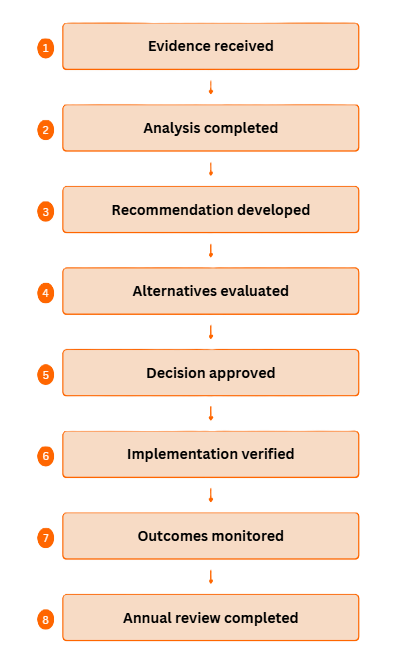
VBGS™ creates Decision Continuity™ by preserving:
the evidence considered,
the assumptions applied,
the alternatives evaluated,
the recommendation made,
the individuals responsible,
the decision approved,
and the outcomes monitored afterward.
The result is a durable record of not only what the organization decided, but how and why it reached that decision.
Better decisions should not depend on institutional memory.
Governance Embedded in the Workflow
Governance Should Be Created While the Work Is Being Done
Traditional governance often reviews decisions after the process is complete.
VBGS™ is designed differently.
Governance is embedded directly into the decision workflow. As work progresses, the system can request required evidence, identify responsible parties, record assumptions, preserve rationale, document approvals, and establish the next review point.
That means governance is not added later as a separate compliance exercise.
It becomes a natural by-product of making the decision properly.
VBGS™
The Governance Layer of Better Decision Making.
Every important decision deserves more than a recommendation.
It deserves documented evidence, transparent reasoning, measurable outcomes, and the ability to understand why the decision was made years later.
Within the Locy Ventures Decision Architecture, VBGS™ serves as the governance layer that brings accountability and continuity to every stage of the decision process.
Benefit Engineering™ determines what should be built.
BenefitScope™ organizes and analyzes the supporting intelligence.
Financial Protection Intelligence™ measures the financial protection created by the decision.
VBGS™ governs the entire process—preserving the evidence, rationale, approvals, outcomes, and review history needed to make decisions transparent, explainable, defensible, and continuously improvable.
Governance transforms individual recommendations into an enduring organizational capability. As people, advisors, technologies, and organizations change over time, the decision history remains intact—creating Decision Continuity™ and preserving institutional knowledge for future decisions.
What VBGS™ Governs
Decision authority and accountability
Recommendation documentation
Supporting evidence and analysis
Compensation and governance controls
Outcome monitoring and continuous improvement
Decision history and organizational knowledge
Why It Matters
Without governance, organizations often remember what decision was made but lose why it was made.
VBGS™ helps ensure that every significant benefit decision can be reviewed, explained, defended, and improved over time.
The objective is simple:
Better Governance. Better Decisions. Better Outcomes.
Core Governance Capabilities
Governance Across the Entire Decision Lifecycle
VBGS™ brings together governance principles, structured workflows, decision records, and continuous oversight to strengthen voluntary benefit decisions over time.
Core capabilities
Decision Authority
Identifies who recommends, influences, approves, and owns each decision.
Evidence Governance
Preserves the information, assumptions, and supporting analysis used.
Recommendation Auditability
Documents how a recommendation was developed and why it was selected.
Decision Continuity™
Maintains the rationale and history of decisions despite changes in personnel.
Compensation Governance
Evaluates whether compensation, responsibilities, and services are reasonably aligned.
Implementation Governance
Tracks required actions, responsibilities, completion, and unresolved issues.
Outcome Monitoring
Connects decisions to subsequent utilization, performance, and financial protection results.
Annual Governance Review
Reopens the record periodically to determine whether the prior decision remains appropriate
Long-Term Vision
A More Accountable Future for Voluntary Benefits
Voluntary benefits have evolved significantly.
The governance of the decisions behind them has not.
Most organizations still rely on annual renewals, spreadsheet comparisons, fragmented documentation, and institutional knowledge. Decisions are frequently preserved as outcomes—rather than as complete, explainable processes.
VBGS™ represents a different future.
Our vision is to help organizations govern voluntary benefits as a continuously improving decision system rather than a series of isolated product transactions.
As the architecture develops, VBGS is intended to help organizations:
preserve decision history,
strengthen accountability,
improve recommendation quality,
monitor outcomes,
maintain continuity across changing teams,
and continuously improve the financial protection created by their benefit programs.
The objective is not governance for its own sake.
It is to help organizations make better decisions today—and ensure those decisions remain understandable, measurable, and defensible in the future.